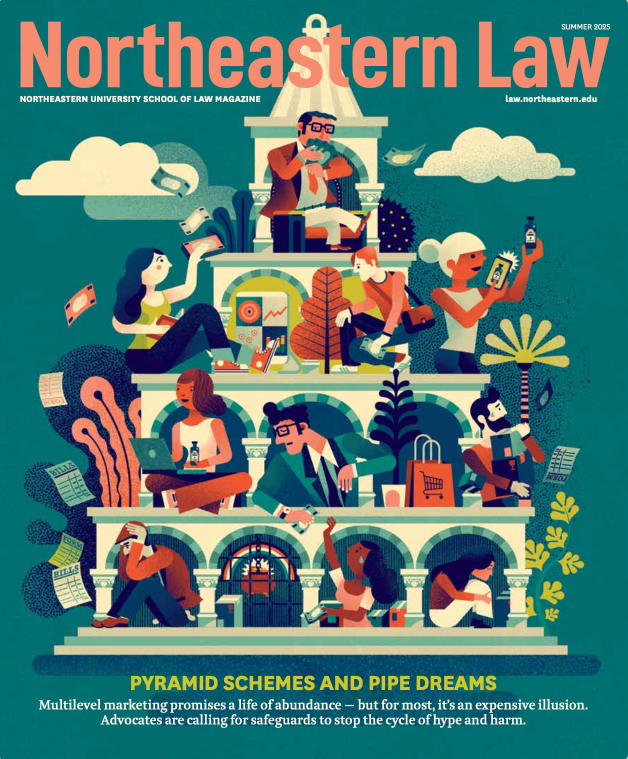
Illustrations by Gwen Keraval
Photographs by Kathleen Dooher
Pyramid Schemes and Pipe Dreams
Multilevel marketing promises a life of abundance — but for most, it’s an expensive illusion. Advocates are calling for safeguards to stop the cycle of hype and harm.
BY ALEXANDER GELFAND
Ever seen an Instagram reel raving about the health benefits of an essential oil? Or a Facebook post claiming you can achieve financial freedom working from the comfort of your own home? If so, there’s a good chance you’ve bumped up against multilevel marketing, a method of selling directly to consumers through networks of sales representatives.
Multilevel marketing companies, or MLMs, present prospective sellers with the opportunity to make money both by moving merchandise (supplements, cosmetics, clothing, housewares) and by recruiting other sellers. Sellers pay a portion of their earnings to the MLM and those higher up in their network and receive a cut of the sales made by the sellers below them. Yet studies show that more than 90 percent of sellers never make a profit.
MLMs once relied entirely on in-person sales: picture Avon reps going door to door or Tupperware “consultants” hosting in-home parties. But these companies now depend heavily on social media, which sellers use to promote products and find new recruits among family, friends and their wider social networks. The companies and their trade organization, the Direct Selling Association (DSA), say MLMs give people the opportunity to build their own businesses. Critics, however, contend that many MLMs are pyramid schemes that use deceptive practices to bilk buyers and sellers alike.
“You have two different sets of people being deceived and exploited,” says Professor Alexandra Roberts, a nationally recognized legal expert on intellectual property and advertising law who surveyed more than 200 sellers and analyzed the initiation agreements used by 167 MLMs for a groundbreaking article, “Multi-Level Lies,” published in UC Davis Law Review.
“On the one hand, you have end consumers who are purchasing products based on misleading claims about what they can accomplish,” says Roberts, a frequent commentator in the national media on MLMs and issues related to intellectual property and social media. “On the other, you have sellers who have been recruited based on deceptive claims about the money they can make and the amount of effort it will require.” Sometimes these groups overlap, since sellers are themselves sold expensive training sessions and required to buy inventory that they must then unload onto buyers.

On the one hand, you have end consumers who are purchasing products based on misleading claims. On the other, you have sellers who have been recruited based on deceptive claims about the money they can make.
This “double exploitation,” says Roberts, leads desperate sellers to make overblown claims about their products while bankrupting those who discover too late that recruiting more people is the only way to make money.
Sarah Petrie ’10 saw this firsthand during her 12 years in the Consumer Protection Division of the Massachusetts Attorney General’s Office. With an eye on federal class action suits against MLMs, Petrie worked with individuals facing home foreclosure, and it wasn’t unusual for her to observe people racking up credit card debt and leveraging their homes to prop up MLMs.
“I had the personal experience of seeing that people had lost their money through predatory MLM schemes,” says Petrie. “We were always concerned about deceptive advertising and marketing claims.”
But the fraudulent nature of many MLMs and their reliance on social media platforms also present ways of reining them in — if, as Roberts argues, the “confusing patchwork” of rules and regulations that govern the companies could be more consistently and aggressively used to protect the people on whom they prey.
Rules Roulette
MLMs are subject to a dense thicket of overlapping rules, regulations and restrictions. At the federal level, the Federal Trade Commission (FTC) is empowered to stop unfair and fraudulent business practices; the US Food and Drug Administration (FDA) regulates health and nutrition claims; and the Lanham Act allows one company to sue another for false or misleading claims that cut into its profits. Most states have unfair, deceptive and abusive practices (UDAP) statutes, consumer protection laws that attorneys general can enforce and private citizens can use to sue violators, indpendently or in class action lawsuits. “UDAP statutes are wonderful tools. The Massachusetts Consumer Protection Law, as interpreted by Massachusetts courts, is meant not only to guard against demonstrable and very real harms to consumers but also to protect market competition among honest businesses,” explains Petrie. “In Massachusetts, courts have acknowledged, and rightly so, that ‘there is no limit to human inventiveness in this field,’ by which they mean scams, unfairness, deception and fraud.”
 In addition, MLMs depend on social media platforms, whose terms of service typically require compliance with all applicable laws and regulations; some platforms even explicitly prohibit MLM content. For its part, the Direct Selling Association funds the Direct Selling Self-Regulatory Counsel(DSSRC), an independent body that issues guidance to MLMs, monitors their products and earnings claims, and refers potential violations to the FTC.
There have been successful actions against MLMs. In 2022, AdvoCare agreed to pay $150 million and was banned from multi-level marketing to resolve charges by the FTC that the company operated an illegal pyramid scheme, deceiving consumers into believing they could earn “life-changing” income as “distributors” of its health and wellness products. In 2023, three distributors for doTERRA were ordered to pay $15,000 apiece in civil penalties for falsely claiming that the company’s supplements and essential oils could treat and prevent COVID-19. (Charges were brought by the Department of Justice at the request of the FTC.)
In 2021, LuLaRoe agreed to pay $4.75 million to settle allegations that it violated Washington State’s anti–pyramid scheme law. An Amazon Prime Video docuseries about the company, LuLaRich, tells the story of how LuLaRoe’s founders, DeAnne and Mark Stidham, grew their company, a clothing wholesaler best known for bold-patterned leggings, by targeting stay-at-home mothers, convincing them to spend more than $5,000 in start-up costs — and encouraging them to raise the money through credit cards, loans and even selling their own breast milk. In 2016, LuLaRoe reported almost $2 billion in sales; since that time, more than 50 lawsuits have been filed against the company, many describing a toxic business environment. The docuseries includes many tearful stories of LuLaRoe’s practices, which destroyed the incomes, marriages and even lives of women who bought into the dream of empowerment only to suffer financial ruin.
Bonnie Patten, executive director of Truth in Advertising (TINA.org), says that MLMs have tamped down their earnings claims in recent years. But they have hardly gone straight. “We’re seeing a pivot to more subtle claims that you can make part-time earnings or small amounts of money to help supplement your income,” Patten says. “But when you look at the data, those claims are, nonetheless, still deceptive.”
Stamping out such practices is difficult for many reasons. Actions at the state level, for example, are limited in scope. The DSA has successfully lobbied to exempt MLMs from various FDA regulations and from the FTC’s Business Opportunity Rule, which requires sellers of business opportunities to give prospective buyers the information they need to evaluate them. And in 2021, the Supreme Court ruled that the FTC no longer had the authority to seek monetary relief as it did with AdvoCare. “Increasing consumer protection has generally received bipartisan support in the past,” says Roberts. “But I don’t expect we’ll see a lot of forward progress in this political moment unless it takes the form of private litigation or more aggressive enforcement of state laws.”
Government agencies also have limited resources, and building a case against an MLM can be difficult. Investigators may have to trace thousands of social media posts made by hundreds of sellers across multiple social media platforms. Proving that an MLM is a pyramid scheme, meanwhile, requires delving into its internal business workings. And witnesses can be hard to come by, in part because sellers are told that if they fail, it is nobody’s fault but their own. “There’s some shame involved,” says Maureen Greason ’24, an associate at Ropes & Gray who worked as a research assistant for Roberts on “Multi-Level Lies.” “If you thought you were going to make a lot of money and you end up losing a lot, you don’t necessarily want to share that.” In addition, the contracts that sellers sign with MLMs are loaded with provisions (arbitration agreements, class action waivers, indemnification and non-disparagement clauses) that make it difficult to sue the companies or speak out against them.

There’s some shame involved. If you thought you were going to make a lot of money and you end up losing a lot, you don’t necessarily want to share that.
“The amount of legal protection MLMs put in place might point toward the fact that they know there could be issues in the future with people wanting to retaliate,” says Greason.
While MLMs do sometimes warn against deceptive practices in the materials they provide to sellers, those documents tend to be so long and so packed with legalese that few people read — much less understand — them: 36 percent of the sellers Roberts surveyed said they were never told there were any limits on the claims they could make, and more than 41 percent weren’t aware of any laws, rules or contract provisions restricting their marketing claims. Anne Probert, who reviewed MLM agreements for Roberts while completing a master’s in media advocacy, got the impression that the companies “were trying to hide this information from their sellers in these massive documents” so they could shift the blame for any misleading claims.
MLMs further avoid liability by arguing that sellers are independent contractors rather than employees, an argument that a federal judge accepted in 2023 when she rejected the FTC’s allegations that Neora, which sells skincare and wellness products, was running a pyramid scheme.
Nonetheless, most experts agree that authorities already have the tools they need to crack down on MLMs. They just need to use them more effectively and against the right targets: namely, the companies and not their sellers.
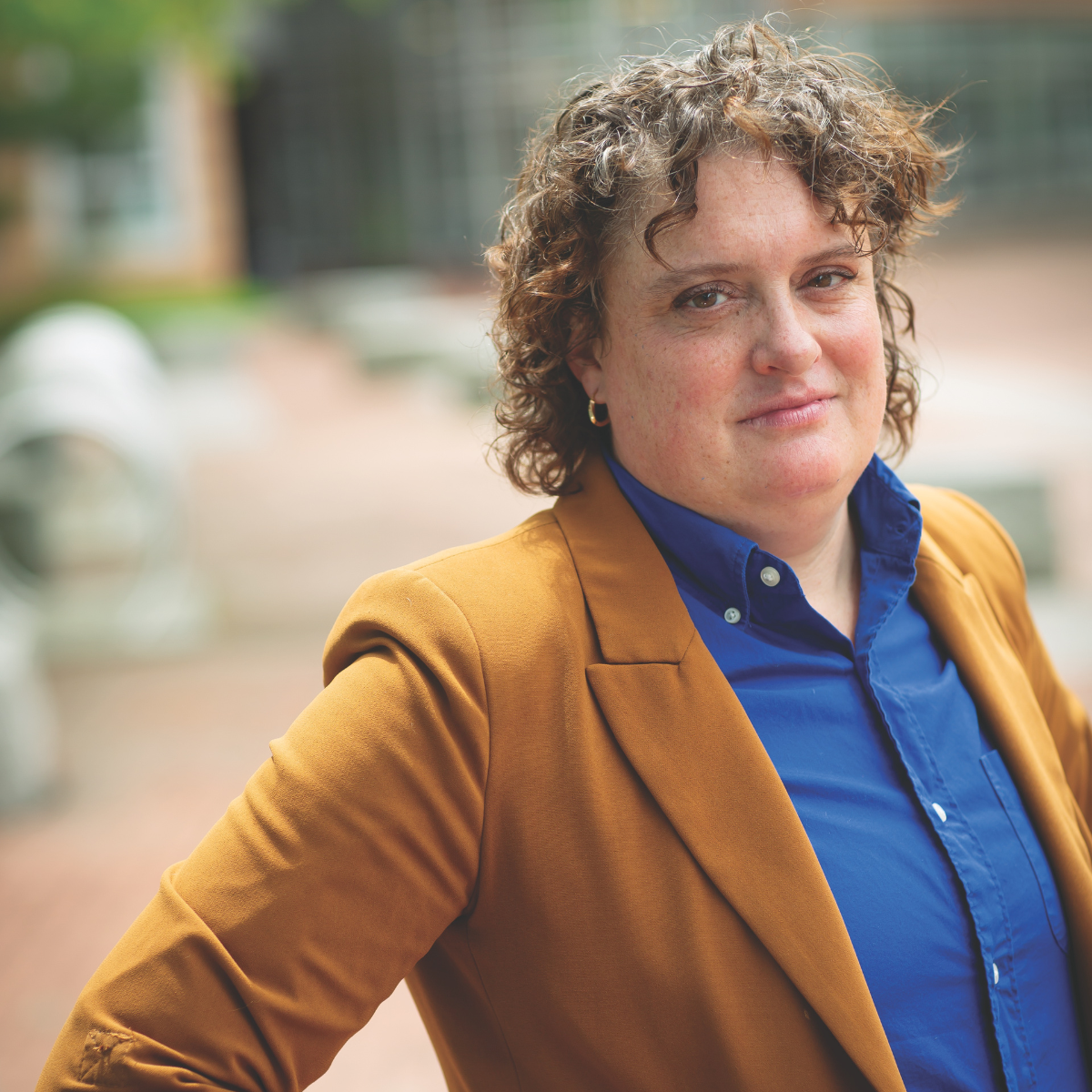
I had the personal experience of seeing that people had lost their money through predatory MLM schemes. We were always concerned about deceptive advertising and marketing claims.
Sold Out
For Roberts, the key issue is that sellers are themselves victims: by touting a fake business opportunity, MLMs trap sellers in a situation where they are likely to lose money and resort to exaggerated claims. “These are regular people who are talking to their friends, people they meet at work, people in a Facebook group they’re in,” explains Roberts. “So they don’t think of themselves as advertisers. They don’t think the law applies to them, and they don’t really know what the law requires.” Brian Frye, a professor of law at the University of Kentucky, adds that to the extent individual sellers honestly believe the claims they make, their right to do so is constitutionally protected. “The First Amendment says you can believe anything you want to, and if you believe it, you’re allowed to say it,” Frye says. Companies, however, are not allowed to make false claims to consumers — and in the case of MLMs, those consumers include the sellers themselves.
The FTC, for instance, could ramp up its efforts to curb deceptive claims by imposing stronger penalties against MLMs. The commission’s proposal to change the Business Opportunity Rule and create a new Earnings Claim Rule could help in this regard. The FDA could regulate supplement claims more consistently. State attorneys general could prosecute violations of consumer protection laws more aggressively. And the courts could shift liability back to MLMs by recognizing sellers as employees.
Increased enforcement and penalties could, in turn, persuade MLMs to better educate sellers and police the claims they make online — perhaps by using the same software tools many already use to track sellers’ social media posts.
“MLMs could be made to do the work,” Roberts says. “Laws that regulate advertising and unfair competition cannot fix all the destruction that MLMs wreak. But those laws provide a means to tamp down deceptive practices by giving agencies, competitors, attorneys general, consumers and platforms avenues for redress, particularly by taking MLM companies to task for the misleading claims they disseminate and the deceptive practices they perpetuate through their sellers.”
About the Author
Alexander Gelfand is a freelance journalist living in New York City who frequently writes about law, business and technology.
Share

During the 2025–2026 academic year, the School of Law’s Center for Public Interest Advocacy and Collaboration (CPIAC) and the School of Public Policy and Urban Affairs created the Northeastern University Law and Policy Fellows Program.

Professor Libby Adler was appointed in January to the Massachusetts Commission on LGBTQ Youth.