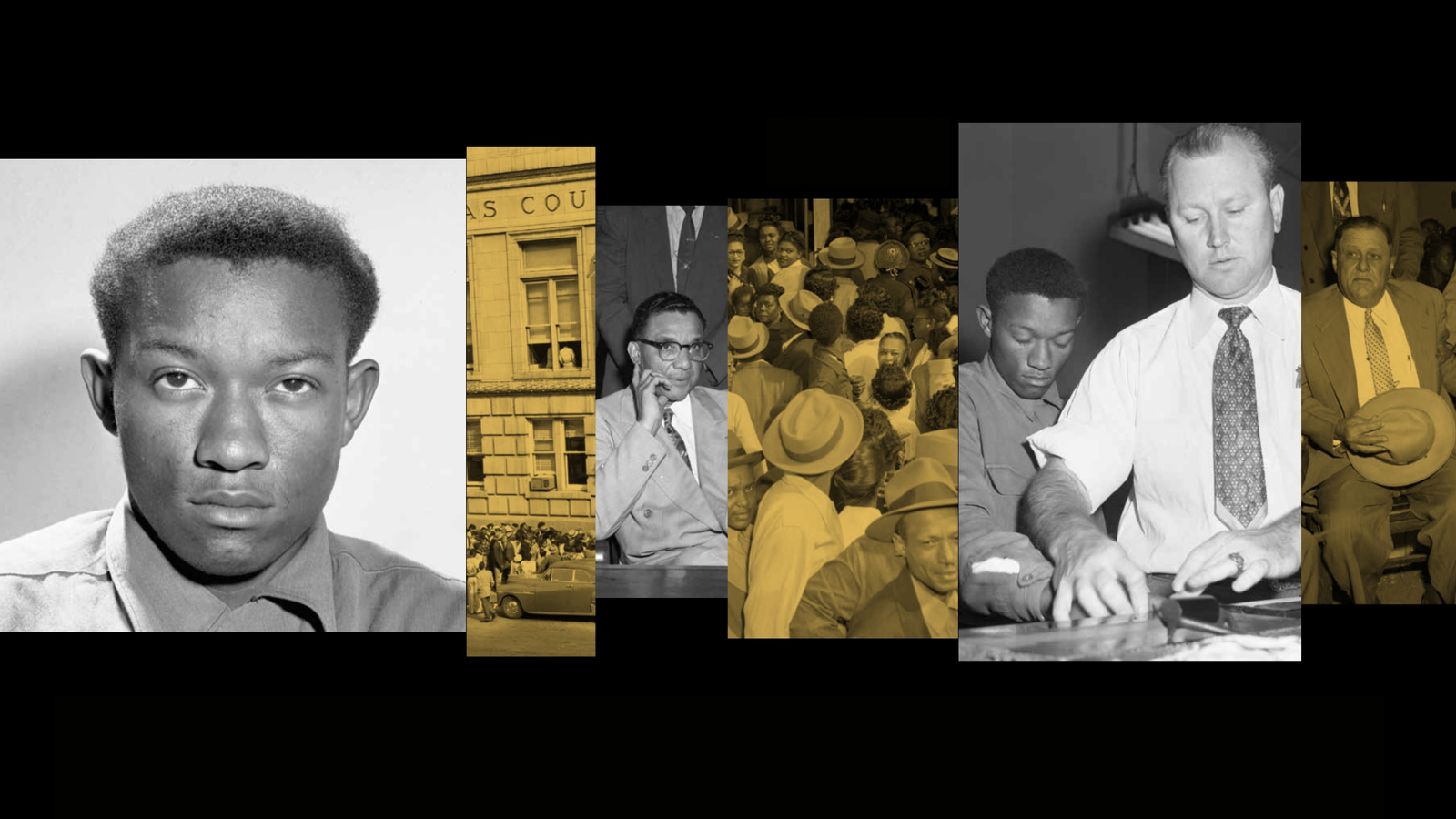
Photographs from the collections of the Dallas History and Archives Division, Dallas Public Library
“I’m Innocent.” 70 Years Later, the Record Agrees
For students working with the Civil Rights and Restorative Justice Project, exonerating the wrongfully executed isn’t a lesson plan — it’s the work.
Case in point: Tommy Lee Walker, executed in 1956.
BY DEBORAH FELDMAN
On May 12, 1956, when Tommy Lee Walker was asked if he had any final words before his execution, he shook his head and said just two words: “I’m innocent.” It took nearly 70 years to prove him right.
On the night in 1953 that Venice Lorraine Parker was murdered in Dallas, Tommy Lee Walker was across town at his girlfriend’s bedside as she gave birth to their son, Edward Lee Smith. Numerous witnesses confirmed it. Walker was arrested, tried and convicted of the crime anyway.
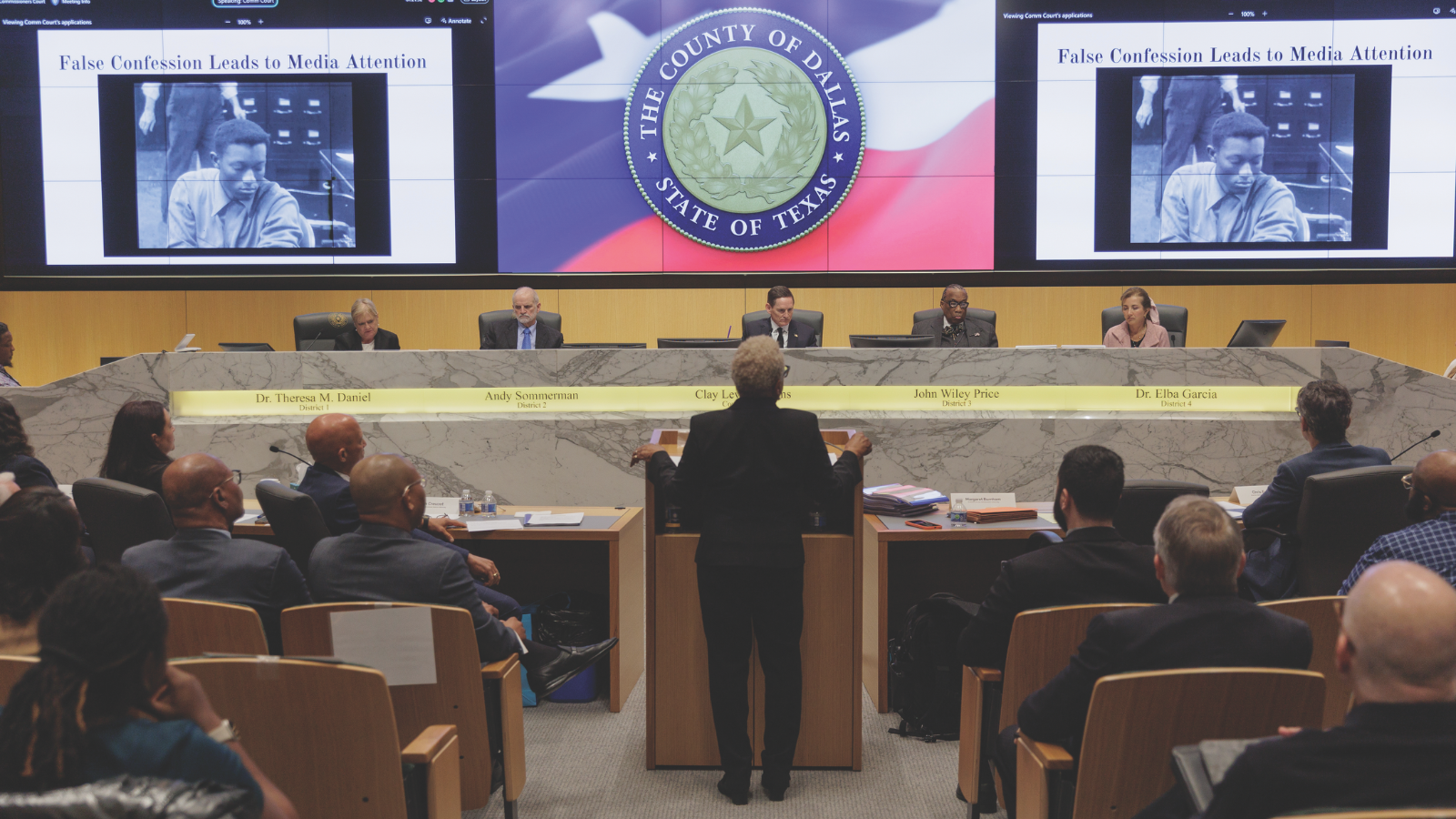
In January 2026, the Dallas County Commissioners Court of Texas unanimously declared that Tommy Lee Walker had been wrongfully convicted and executed — a resolution that brought Smith, now in his seventies, to tears. The pain, he told the court, had never subsided. “Growing up without a father was hard for me. It hurts every time I talk about it. Because I miss my father, I miss him dearly,” he said. But the final resolution offered something, too. “This restores my daddy’s name.”
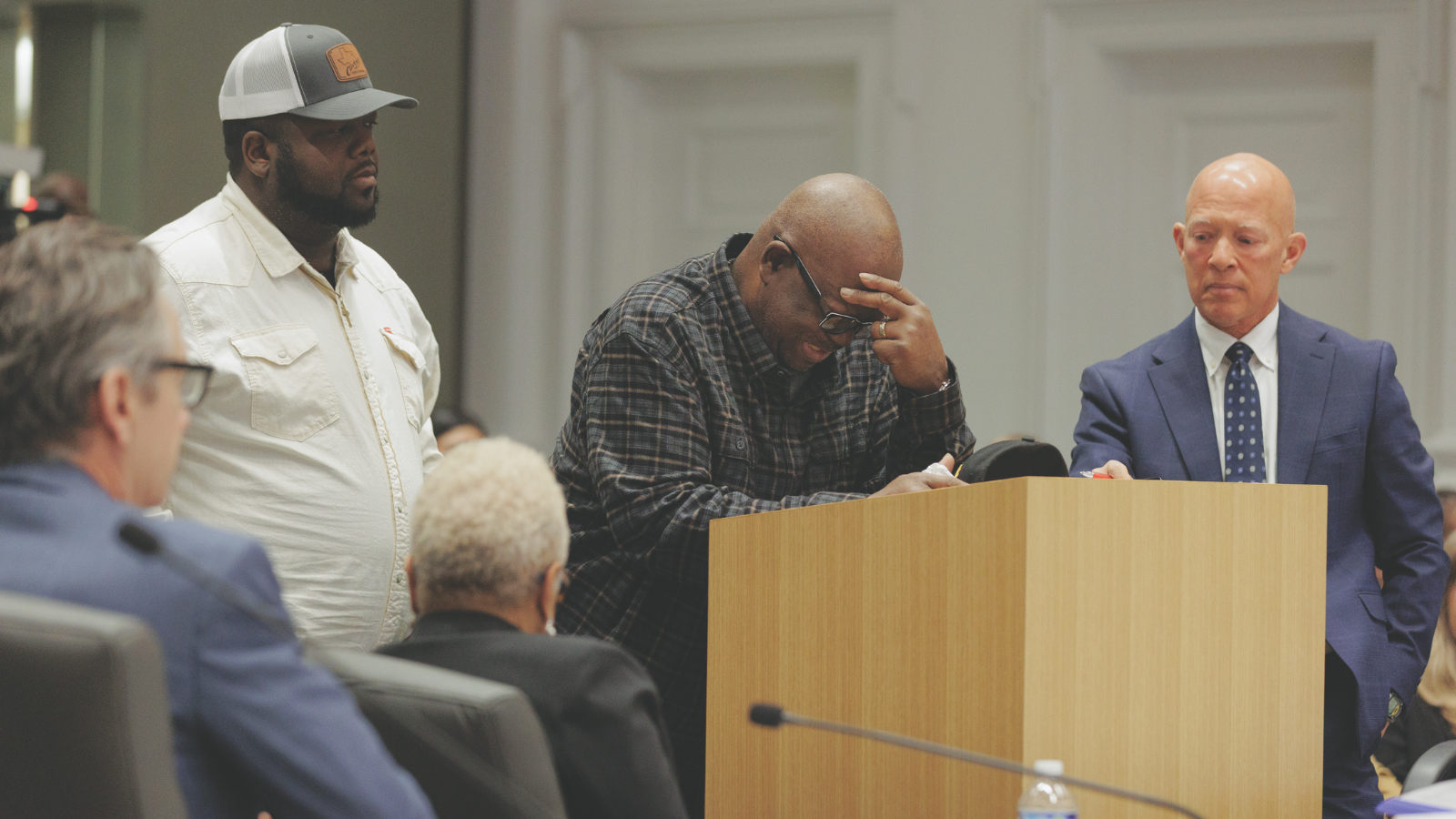
Edward Lee Smith (center), the son of Tommy Lee Walker, testifies before the Dallas County Commissioners Court of Texas in January 2026.
Photograph by Shelby Tauber for the Innocence Project
One question haunts every wrongful conviction case: How does an innocent person end up on death row? In Walker’s case, the answer is a cascade of failures, each one compounding the last. A racially charged investigation. A coerced confession with fabricated details. Flawed eyewitness identifications. A prosecutor who withheld evidence and then brazenly took the stand to proclaim his personal belief in the defendant’s guilt. And an all-white jury that quickly sent a young Black man to his death for the murder of a white woman. No single failure killed Tommy Lee Walker; the system did.

Sindhu Iyengar ’27 (left) with Alex Stein ’19, CRRJ program director and staff attorney. Iyengar’s archival digging helped bring a human voice to the Walker brief.
Photograph by John Soares
Growing up without a father was hard for me. It hurts every time I talk about it. Because I miss my father, I miss him dearly.
“The legal system has to correct its errors, especially its fatal errors, and that is exactly what this case is,” says Professor Margaret Burnham, founder and director of the law school’s Civil Rights and Restorative Justice Project (CRRJ), who served as co-counsel to Smith and argued the case before the commissioners court. “Our courts have to take a look at these cases and figure out what measure of justice can be afforded at this moment for thousands of African Americans across the country. As with many of our cases, this investigation involved reverse engineering a travesty.”
The engineers, it turns out, were law students.
As a co-op student with CRRJ, Sindhu Iyengar ’27 was looking for social justice experience to complement her corporate law career aspirations. She expected to do what lawyers do: research and write. And she did, making significant contributions to the 150-page brief submitted by CRRJ and its partner in this case, the Innocence Project. By the time she joined the case in summer 2025, much of the investigative groundwork had already been laid, but the brief still needed what Burnham called “narrative strength.”
That meant finding Tommy Lee Walker inside the documents.
Iyengar and fellow co-op student Maya Quirk ’26 combed through newspaper accounts — biased, they knew — and police reports signed by a lead prosecutor they knew had coerced Walker’s confession. Then Iyengar found an interview with Walker conducted by an investigator for the Texas Board of Pardons and Paroles. Among the many questions: What did he like about school? What were his favorite subjects?
Biology, Walker told the investigator, was his favorite subject.
Reading those words was “completely jarring for me,” says Iyengar, just a handful of years older than Walker was at the time of his death. “It made me realize this happened to someone who was so unbelievably young that he had a favorite school subject. I pulled out little nuggets like that from many pages. One line mentioned that he really liked music, so I pulled that out for the brief.”
Law in Practice
Most law students spend their education learning how the system works. In this case, CRRJ students learned how the system fails — and what it costs when it does.
For Burnham, that distinction is the point. Working a case like Walker’s requires students to move through the entire arc of a prosecution — from the night of the crime to the moment of execution. They must reconstruct not just what happened but why. “They’re trying to figure out the thinking of the prosecutor, the investigators,” she says. “They have to put themselves in each one of those peoples’ shoes to see what went wrong, and how, and why.”

Tommy Lee Walker’s son, Edward Lee Smith (left), embraces Venice Lorraine Parker’s son, Joseph Parker, during the hearing in Dallas in January 2026. “In a moment that transcended generations of pain, Tommy Lee Walker’s son and Venice Parker’s son were both present and met for the first time. Parker’s son affirmed what the evidence makes clear: Tommy Lee Walker was innocent,” said the Dallas County Criminal District Attorney’s Office in a statement.
Photograph by Shelby Tauber for the Innocence Project
That kind of thinking, Burnham argues, can’t be found in a casebook. “Students are working on an unusual case, often one of first impression, where the outcome is in the hands of the advocates, and they’re critical members of that team.” The students aren’t witnessing the law; they’re practicing it, with real consequences for a real family.
Burnham credits more than a dozen law students and CRRJ Elizabeth Zitrin Justice Fellows with thousands of hours of research that turned up both what they expected and some surprises. “A member of our CRRJ team made the critical discovery that the investigator who obtained false confessions from Tommy Lee Walker had been a member of the Ku Klux Klan,” explains Burnham. “In our research, we turned over every stone. And that find — that the lead investigator had been in the Klan — underscored the authorities’ antipathy towards Walker in this racially charged case.”
Alex Stein ’19, CRRJ’s program director and staff attorney, who supervises co-op students and research assistants and himself participated in the clinic as a student, describes the work as cultivating a particular kind of legal mind: one that is both creative and relentless. There are questions upon questions to be answered, he says: “What’s the next layer down? And what’s the next layer after that? What else was happening at the time? What bias might the person who wrote this report have had?”
“We really emphasize the importance of being precise and being thorough, because that is what it takes to win one of these cases,” says Stein.
Even so, the Walker case demanded more than tenacity. It required students to hold two kinds of knowledge simultaneously: the forensic and the historical. “We need to have a really good understanding of how the science works,” Stein says. “We also have to have a really good understanding of what the social environment was like in Dallas at the time. If you have one without the other, the argument isn’t going to be as effective.”
Working alongside the Innocence Project — which specializes in forensic and legal wrongful conviction claims — allowed CRRJ to contribute what it does best: The deep historical and racial context that turns a legal argument into a coherent and human story.
Among the lessons Burnham most wants students to absorb: these cases are never just history. Walker’s execution, she explains, “not only robbed him of his life but also enacted a kind of posthumous punishment so long as his legacy was that of a murderer. Posthumous relief could not bring him back, but it was a way to mitigate that dishonor, not just for his living relatives but also for history. Students need to grasp how legal tools, creatively employed, can help us as a nation to see ourselves in relation to the past.”
Talia Lanckton ’26, a former research assistant with CRRJ, says the experience reshaped how they think about what the law can actually do. “Acknowledgment isn’t necessarily just a gesture or a statement,” says Lanckton. “It can be the first step of a process that actually has a real, material impact in people’s lives. This experience has given me an appreciation for that.”
Built for This
The Walker case is the newest front in a body of work CRRJ has been building since its founding in 2007. Students in the CRRJ Clinic have long investigated lynchings in the Jim Crow South and compiled the Burnham-Nobles Digital Archive, one of the most comprehensive digital records of racial homicides in existence. The Wrongful Execution Project, through which the Walker case was investigated, is CRRJ’s most recent initiative, focusing on cases where the legal system didn’t just fail but also killed.
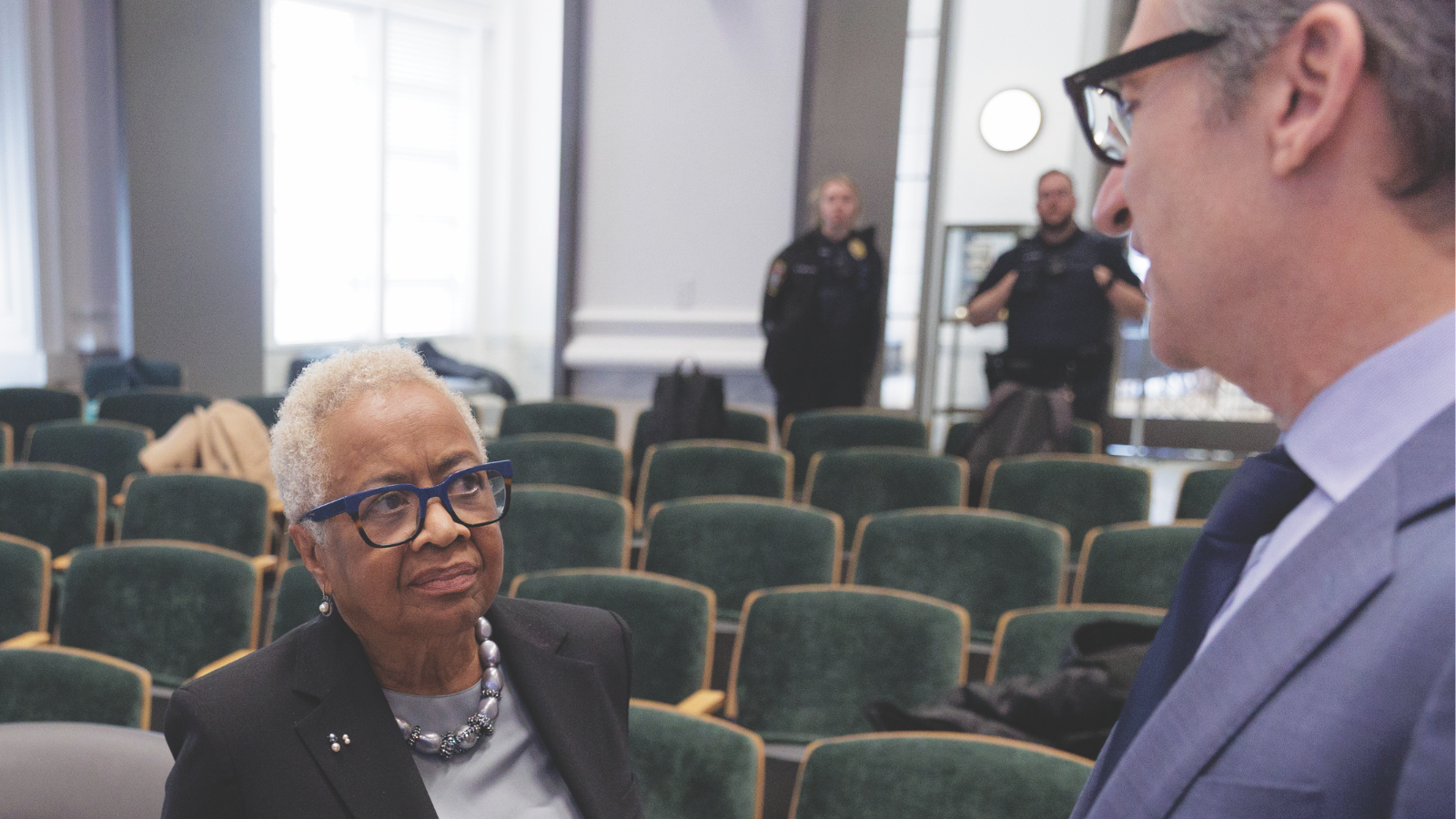
Professor Margaret Burnham (left) served as co-counsel to Edward Lee Smith in the fight to clear his father’s name.
Photograph by Shelby Tauber for the Innocence Project
In 2022, Ben Weinberg ’90, pro bono partner at Dentons and co-founder of the Law Firm Antiracism Alliance (LFAA) — a coalition of more than 300 law firms providing pro bono hours to legal services organizations challenging racial inequity — launched a partnership with Burnham to take on what she calls legal lynchings: cases where the machinery of the courts was used to accomplish what a mob might have done outside them.
“I first approached Margaret Burnham in 2022 after reading her book, By Hands Now Known, to see how LFAA could help CRRJ,” said Weinberg. “Margaret asked us to do a 50-state survey of the laws of posthumous pardons to assess whether posthumous pardons, with a specific focus on wrongful executions, could be a logical extension of CRRJ’s work. Based on that research, LFAA is now working with CRRJ on multiple wrongful executions.”
CRRJ has many other cases like this across the country, dating back to the Jim Crow era. Our courts need to determine what measure of justice can be afforded…
Burnham is clear-eyed about what posthumous exoneration can and cannot do. It cannot give Tommy Lee Walker his life back. It cannot undo what his execution meant for his son or for the hundreds of people in Dallas who knew Walker was innocent and said so loudly at the time. But it can change what his death means — legally, historically and for his family.
“CRRJ has many other cases like this across the country, dating back to the Jim Crow era,” she says. “Our courts need to examine these cases and determine what measure of justice can now be afforded to the families of the wrongly executed.”
For the students who work these cases, the measure of what they gain is harder to quantify — but no less real. Iyengar came to CRRJ expecting to build legal research and writing skills, which she did. She also came away with something she didn’t expect: the story of a 19-year-old boy who liked biology and music, pulled from the margins of a file that had spent 70 years waiting to be read. “It was clearly a labor of years and years of very principled work,” she says of the brief she helped write, “by people who really cared about the project.”
Tommy Lee Walker said he was innocent. It took law faculty and students years of archival work, a partnership with the Innocence Project and the unanimous vote of a Texas commissioners court to make the record agree.
For Edward Lee Smith, finally, his father’s name is restored.
For the students who helped restore it, the work is over. The lessons carry on.
About the Author
Deborah Feldman is editor of Northeastern Law magazine.
Share

A legal theory developed at Northeastern Law’s Action Lab at the Center for Health Policy and Law has produced its first landmark result.
In Donte J. Carter v. United States, the DC Court of Appeals cited Professor Aliza Hochman Bloom’s Stanford Journal of Civil Rights & Civil Liberties article